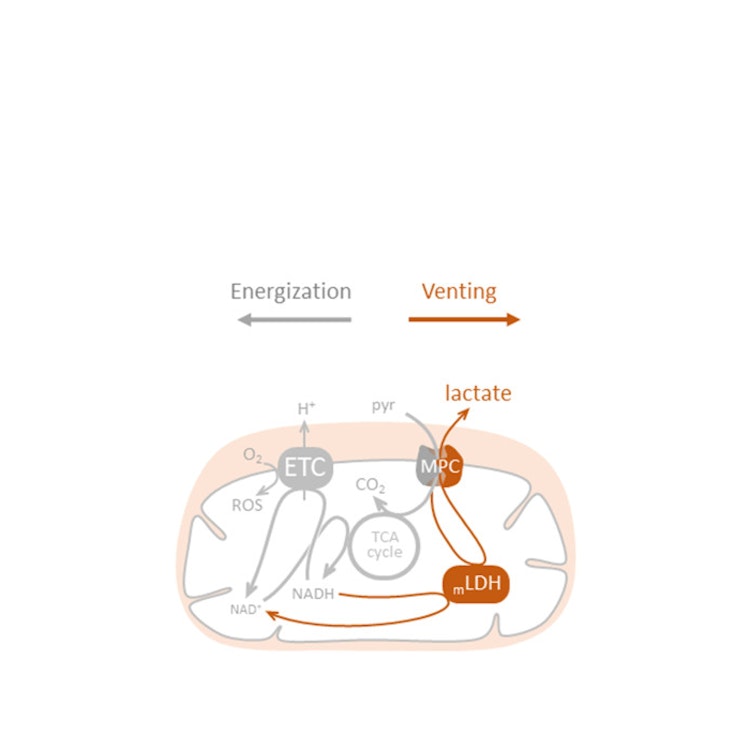
Mitochondrial lactate venting limits oxidative stress
Lactate has been proposed to enter mitochondria and fuel respiration, but this “intracellular lactate shuttle” remains controversial. Using genetically encoded lactate and redox sensors in cultured cells and neurons in vivo, we identify a dynamic lactate pool within the mitochondrial matrix that tracks extracellular and blood lactate and promotes lactylation of mitochondrial proteins. Lactate crosses the inner mitochondrial membrane through a saturable pathway that is partly sensitive to pharmacologic and genetic inhibition of the mitochondrial pyruvate carrier (MPC). Despite transport and matrix lactate dehydrogenase activity, lactate does not measurably energize the electron transport chain under the conditions tested. Instead, energized mitochondria can produce lactate from pyruvate, a response enhanced by hypoxia. Blocking MPC causes matrix lactate and H₂O₂ accumulation, revealing a rapid lactate-based “vent” that modulates matrix energy and reactive oxygen species.
Download
rauseo-2026.pdfResearchers


